Die Handling Cranes

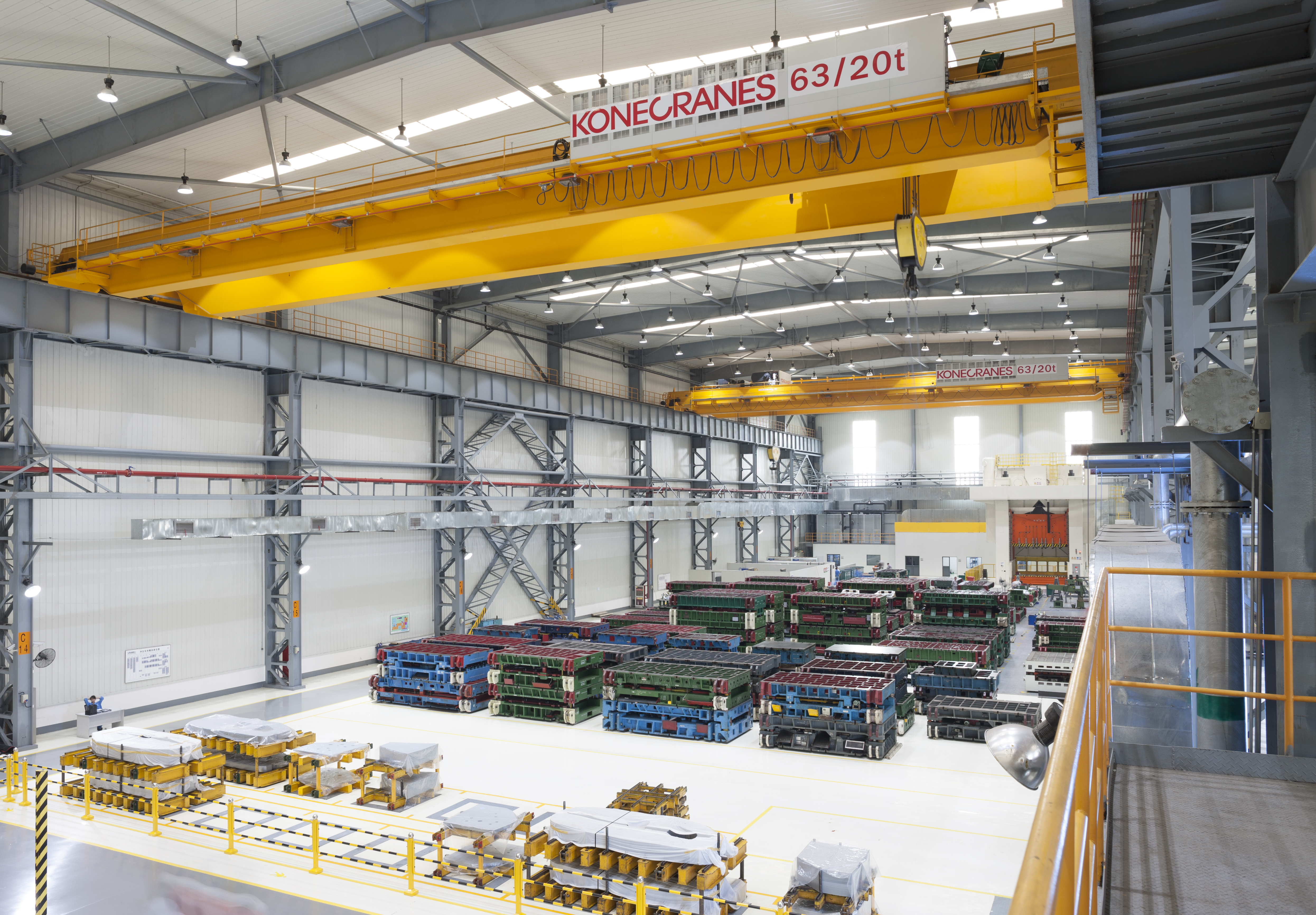
The core process cranes in the automotive industry are used to transport dies from storage to the press for loading the press and from the press back to storage. Die handling cranes are also used for turning dies for maintenance purposes. Konecranes has been supplying customized process cranes to the automotive industry for more than 40 years.
Konecranes die handling cranes are typically double-girder bridge cranes that can be equipped with various trolley configurations such as two winches on a common trolley or two individual trolleys, motorized rotating load hooks, or manually adjustable load crossbeams. Our Konecranes M-series and SMARTON open winch cranes are perfectly suited for die handling tasks.

  • Two hoist trolley (THT) or separate trolley solutions
  • Special features for safer load turning, rope angles up to 10 degrees possible
  • Overload protection—system consists of load cells and overload detection unit
  • Overspeed control of variable speed hoisting
  • Smart Features
  • Joystick Radio and pendant for backup and maintenance use
  • Second brake for hoisting can be provided
  • Frequency controllers for main movements
  • Emergency brake
  • TRUCONNECT Remote Monitoring
  • Electrical room is pressurized and air-conditioned
 

M-series

Smarton

FEM

M6–M8

M5-M7

Trolley Type

Open winch

Open winch

Lifting capacity (Main hoist)

Up to 63T

30-63 ton

Lifting capacity (Aux hoist)

20-32 tons

20-32 tons

Span

up to 35 m

up to 35 m

Lifting height, max

Tailored

Tailored

Bridge / trolley travel speed

Tailored

Tailored

Manual Control

Radio/Pendant

Radio/Pendant

Bridge/Trolley power supply

Conductors/Festoon

Conductors/Festoon

Motor control system

Konecranes Variable Frequency Drives (VFD)

VFD

Electrical Braking

Resistors/Regenerative network braking units optional

Resistors

  • Hoist synchronization provides fast and precise load handling
  • Load turning features enable safe operation
  • Semi-automated Smart Features help improve safety and productivity
  • TRUCONNECT Remote Monitoring provides data for maintenance planning and assessing crane condition and safety

Die Gripper Cranes

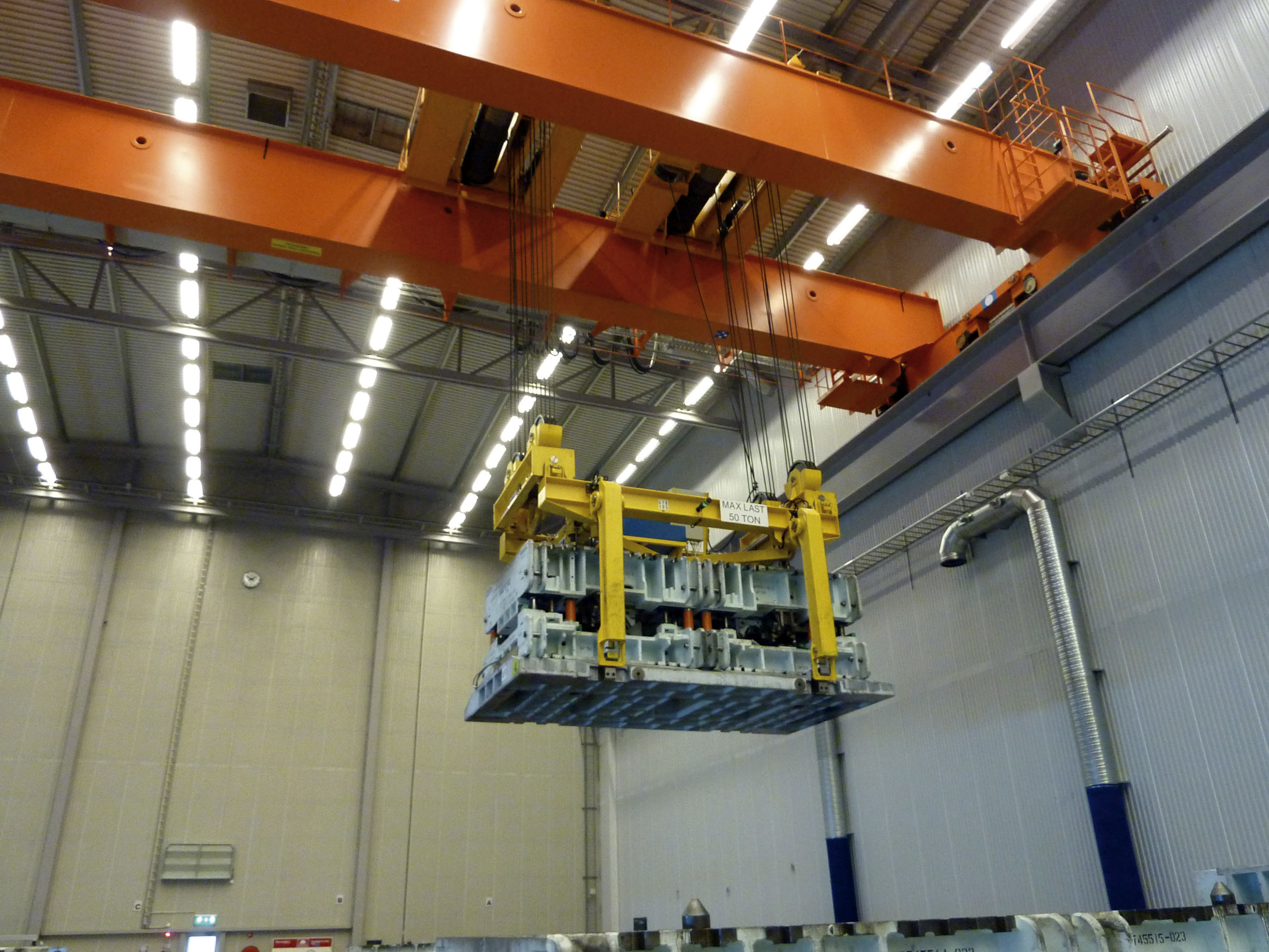
In the press shops of the automotive industry, more than a million car body parts of various shapes and sizes for multiple models are produced every day. Due to this high variance, press die set needs to be changed frequently requiring shorter press-cycles. Die grippers enable fast, compact and multi-level die storage offering a significant improvement over conventional slinging equipment such as chains or ropes.

Our die gripper cranes are custom designed for die handling in the automotive industry and are available with intelligent sensor technology, advanced Smart Features, and a precise positioning system for the safe and efficient transport of press dies.

  • Trolley with coupled open winches
  • Design of all components considering a center of gravity eccentricity of 100mm, related to the max. die weight
  • Stable 4-point load suspension with balancing rocker
  • Millimeter-precise pendulum-free positioning
  • Redundant laser or barcode measuring systems
  • Sway Control
  • Die gripper with integrated slewing gear
  • Uniform utilization of the rope strands due to integrated compensating rocker
  • Ropes tested for this application with high structural stability and high breaking load
  • Optional rope drive
  • Synchronized sensors designed redundantly and are evaluated in a fail-safe programmable logical controller (PLC)
 M-series die gripper crane
Crane classification EN 13001 U-class (load cycles)U7
Crane classification EN 13001 Q-class (load collective)Q5
Hoist classification (FEM/EN)M7/A7
Trolley type2 coupled open winches
Duty cycles gripper2 million
Load capacity on tool gripperUp to 66 tons
Die dimensions (length)1.650-4.850 mm
Die dimensions (width)1.200-2.850 mm
Die dimensions (height)1.600 mm
Positioning accuracy+/-10 mm at the gripper
Positioning accuracy of the load rotation angle+/-0.2 degrees at the gripper
SpanUp to 40 m
Lifting height, max.15 m
Lifting height with load12 m/min
Lifting height with empty gripper18 m/min
Bridge travel speedUp to 100 m/min
Trolley travel speedUp to 40 m/min
Trolley power supplyEnergy chain or festoon cable
Manual controlRadio/pendant
  • Faster die change
  • Safer die handling (pick-up, transport and drop off)
  • Efficient, space-saving utilization of the available storage area
  • Cranes and die grippers are customized as per customer requirements
  • Optimized reeving with a minimum of rope sheaves gives a maximized rope service lifetime.
  • Different level of automation possible: From manual operation to semi-automatic to fully automatic in combination with the Konecranes Warehouse Managing System
  • Intelligent sensor technology recognizes safe load pick-up and detects the surrounding area of gripper to avoid collisions.
  • All safety-relevant functions are controlled in performance level d (PL d), category 2, according to EN ISO 13849-1—this also includes bypassing restrictive areas and route-guided target positioning
  • Crane and WMS Status visualizations on mobile devices
  • Excellent accessibility to all components for maintenance and service activities
  • Remote monitoring capability for informed maintenance planning

Coil Handling Cranes

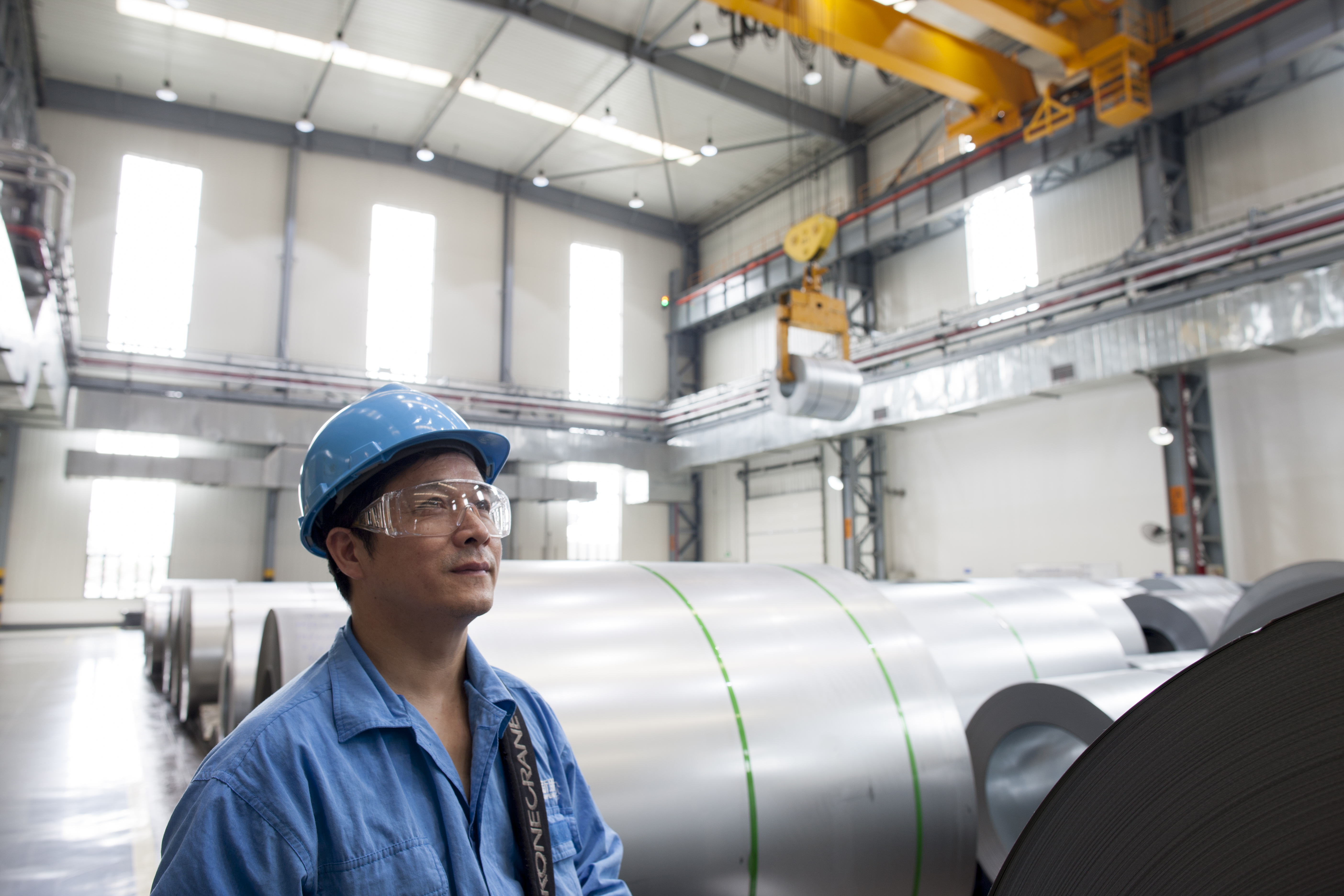
A coil handling crane delivers steel coils for unreeling and blank cutting. Once the steel is pre-cut to the right size—these pieces, or blanks—are pressed in a stamping machine to form the parts of a car body, such as the hood, doors, trunk, roof, and so on. Pressing involves a sequence of three to five consecutive stamping operations with forces ranging from 1,000 – 25,000 kN to produce the part.

Our coil handling cranes are designed to travel long distances at fast speed to keep work cycles short for the demanding production schedules of the automotive industry. Konecranes M-series or CXT cranes can provide safer and easier coil handling and can be customized for your specific requirements.

  • Special heavy-duty trolley
  • single or multi-trolley arrangement
  • Smart feature
  • Stiff box-type steel structure for the bridge and trolley
  • Variety of speed range available.
  • Heavy-duty hook block
  • End-carriages/bogies are heavy duty with hardened wheels.
  • Truconnect remote service capability 
 M-seriesCXT Smart
Duty cyclesUp to 2 million250,000
FEMM6-M8Up to M6
Trolley typeCompact open winchCompact rope hoist
Lifting deviceC-hook, coil magnet or coil grabC-hook, coil magnet or coil grab
Lifting capacity, max.Up to 63tUp to 80t
SpanTailoredTailored
Lifting height, max.TailoredTailored
Bridge/trolley travel speedTailoredTailored
Manual/automated controlCabin/radio/pendantCabin/radio/pendant
Bridge/trolley power supplyConductors/festoonConductors/festoon
Motor control systemKonecranes variable frequency drives (VFD)Konecranes VFD
Electrical brakingResistors/regenerative network braking units optionalResistors
  • Designed to maximize the working cycles per hour
  • Precise and fast load handling with travelling speeds.
  • Heavy duty use with trolley.
  • Longer life and more return on investment due to core of lifting components
  • Reduced vibration with stiff box-type steel structure
  • Sway Control and Slack Rope Prevention available as an add on feature helps improves work area safety and productivity.
  • Reduced cycle times with semi- and fully automated functions
  • Simplified and minimized maintenance costs.
  • Energy savings due to Regenerative braking (optional)

Warehouse management system modules for die handling

WMS Smart Features

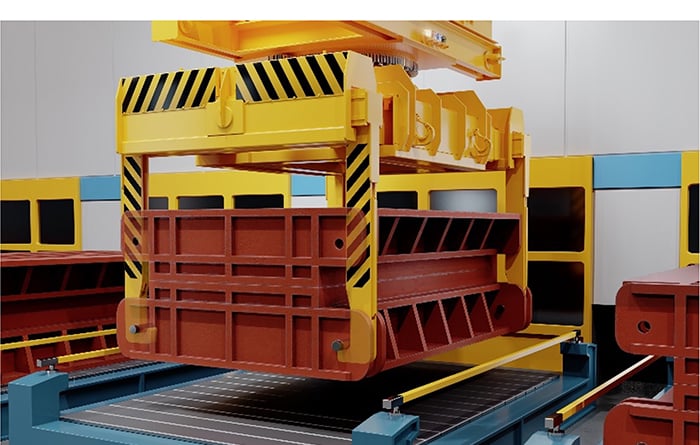
Automotive die being lifted by craneKonecranes WMS Smart Features (SF) are designed for streamlining daily operations, providing operators with support, and minimizing the risk of errors. Smart technology and an intuitive interface make Smart Features an ideal solution for efficient and reliable die storage management.
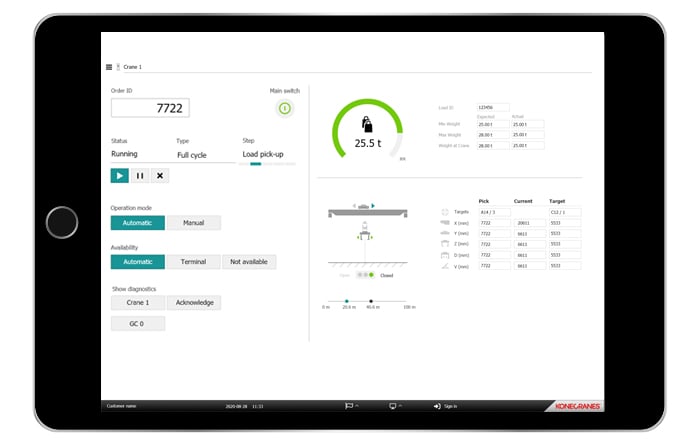
Before a die is stored, die information is entered into the WMS and then the operator can lift the die manually with the gripper crane to use the teach function. By teaching a die, the RFID information will be read from the RFID tag and saved to the die information along with the measured weight and the gripper leg width position, saving the operator time and helping prevent mistakes in the RFID information.

To further support the operator, the WMS automatically sends the sequence of transport orders that is required for a die exchange to the crane. If the die gripper crane is operated in semi-automatic mode with the radio control, the WMS visualizes the currently selected destination in the storage layout.

Benefits
  • Streamlined daily operations help increase safety and minimize the risk of errors.
  • Operators are provided with support for efficient and reliable die storage management for enhanced reliability.
  • The WMS Smart Features are easy to use, making operators’ work more efficient.

Production Management Module

Konecranes production management moduleThe Konecranes WMS Production Management Module (PMM) extends the WMS using a specially designed production optimization algorithm to determine the most efficient die exchange sequences.
Die exchange jobs are activated via WMS dialog by an operator to send transport orders to the crane. The die exchange is carried out in an optimized sequence with the goal of completing a die exchange without any empty drives. This ensures optimized die exchange times. The WMS also decides the optimum storage location for each die.

The mobile PMM supports the operator during die exchanges and provides all relevant information about the current job and transport order as well as crane positions.

Benefits
  • The WMS production optimization algorithm provides increased efficiency of die exchanges.
  • The mobile PMM helps make operators more efficient with visibility to transport orders and crane positions.

Material Flow Module

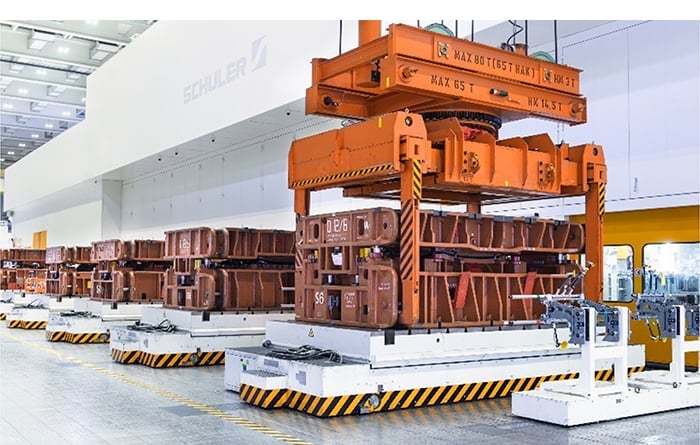
Automotive die transferThe Konecranes WMS Material Flow Module (MFM) controls the material flow of the dies outside the die storage area on the press bolster positions as well as on teaching positions or die transfer carts.

The automated guided vehicle (AGV)/conveyor interface provides the seamless transfer of dies from the die storage area (DSA) to AGVs such as die transfer carts or conveying positions such as press bolsters. This interface provides efficient movement of dies and enables fully automatic handling throughout the entire die change process, reducing the chances of injury and increasing productivity.

The integration of AGV and conveyor systems into the WMS helps optimize material flow for improved overall operational efficiency. The MFM communicates with the AGVs through wireless communication or cabling within your own network and provides them with instructions on pick-up and delivery points. Die pick and deposit at the press bolster positions can also be performed in fully automatic mode with the MFM.

Benefits
  • Fully automatic die exchanges provide a safe and efficient transfer of dies from the DSA to AGVs and conveyors.
  • Integration of AGV and conveyor systems into the WMS optimizes material flow and improves operational efficiency.