Konecranes Portal provides a single point of access to our digital customer platforms for industrial equipment, port solutions and lift trucks. View maintenance information and TRUCONNECT data, browse the store for spare parts, accessories and manuals, and discover what Konecranes has to offer.
In 2019, we launched the Konecranes S-series hoist with synthetic rope instead of traditional steel wire rope. Since then we've sold hundreds of S-series hoists to customers around the world who are thrilled with the cleanliness and durability. And we just recently introduced a low headroom version of the popular S-series hoist and the revolutionary Konecranes X-series crane.
We’re the first company to produce overhead cranes with synthetic rope as a default and we’ve put it through extensive lifetime tests to ensure safety, strength and durability. The synthetic rope we use in our hoists is made with Dyneema®—one of the world’s strongest fibers—which has been used for more than 30 years in demanding rigging applications such as lifting slings, mooring and towing large sea vessels. Lives also depend on it during search and rescue operations and mountain climbing. So keep reading to learn all about synthetic rope and how it compares to steel rope.
Strong and durable
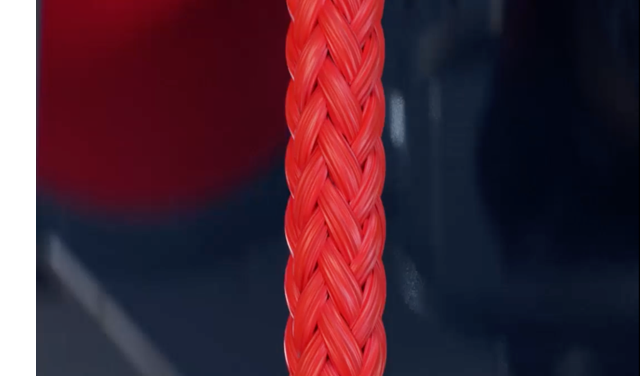
The synthetic rope has a 12-strand non-rotating structure that is hollow inside. The stable structure of the rope removes or substantially reduces the risk of certain rope defects that steel ropes are prone to like birdcaging, waviness, core protrusion and kinks.
And while steel rope has multiple variations such as rotation resistant, heavy duty, left and right hand, galvanized and stainless steel, or for different lubrication—there is only one variation of the synthetic rope to fit the same applications.
The lightweight rope is easy to handle and doesn't fray or produce sharp barbs, minimizing the risk of cuts on the hands of anyone handling the rope. There's also no need to worry about broken steel wires contaminating the area or load.
It’s a perfect combination when the rope is clean and there are no sharp edges, barbs or grease like in the steel rope. It is very user-friendly rope material.
No need for lubrication
The strands, yarns and fibers of the synthetic rope slide easily against each other so there’s no need for additional lubrication and the hoist drum is pre-coated to prevent corrosion.
You'll save time during maintenance as there's no need to wash away lubricant for inspection or add lubricant. There's also no need to worry about lubricant from the rope harming the process below the crane.
It may just be lubricant - but the small details add up.
We have really appreciated the cleanliness of the rope and the fact that it does not stain our valuable process or crane operators' hands.
Increased lifetime of reeving components
Synthetic rope sits evenly against the reeving components, minimizing surface pressure and leaving virtually no imprints that can potentially decrease the useful lifetime of the reeving components. The rope also slides easily against the guiding surfaces of the reeving components helping increase their useful lifetime. Easy sliding also means less heat loss and improved mechanical efficiency of the whole reeving system.
Another one of those little details - dust. Unlike steel rope, synthetic rope doesn't attract and collect dust that can cause accelerated wear of rope and reeving components.
We are proud to show our factory to our own customers who are paying a visit when there is such high technology and modern synthetic rope in our overhead cranes. Gives a good impression that we care and want to have the best technology in our processes!
What kind of applications can synthetic rope be used in?
In general, synthetic rope is suitable for any normal indoor overhead crane lifting application—within temperature range—such as general manufacturing, automotive, metals production, paper and forest and food production.
It offers excellent resistance against most chemicals and it doesn't attract and collect dust like steel rope. The expected lifetime of synthetic rope is at least as long as a comparable steel rope and it is very difficult to unintentionally damage a synthetic rope.
Rope comparison
FEATURE
SYNTHETIC ROPE
STEEL WIRE ROPE
Low temperature
-40 C (-40 F)
-20 C (-4 F)
High temperature
+40 C (+104 F)
+55 C (+131 F)
UV resistance
Medium resistance
High resistance
Humidity
Maximum resistance
Good resistance
Clean assembly/maintenance
Cleaner
Lubricated steel wire prone to attracting dirt
Dust/abrasion
Resistant to abrasion
Lubricated steel wire prone to attracting dust and accelerating abrasion
Electrical conductivity
Non-conductive in dry environments
Conductive
Corrosion
Acid/alkyd resistant
Highly corrosive to acid/alkyd
Rust
Rust-proof
Subject to rust
The data is based on the use of a hoist/crane in a normal and recommended manner, under standard conditions. This is not a warranty.
FEATURE
SYNTHETIC ROPE
STEEL WIRE ROPE
Material
High performance synthetic
High strength steel
Breaking strength
Very high: consistently exceeds 5:1
High: meets or exceeds 5:1
Construction
Braided
Strands
Rope variations
One
Multiple (left lay/right lay, etc.)
Shape retention
Retains and/or returns to original shape
Does not retain original shape
Friction
Low coefficient of friction increases rope life
High coefficient of friction reduces rope life
Rotation resistant
No (rotation resistance requires a special rope)
Visibility
High visibility red
Low visibility gray
Weight
Light: 80% lighter than steel
Heavy
Kink resistance
Will not kink
Will kink, requires replacement
Resistance to bending
Returns to original shape with no permanent damage
Will bend and deform, requires replacement
Bird cage resistance
Returns to original shape with no permanent damage
Will bird cage and deform, requires replacement
The data is based on the use of a hoist/crane in a normal and recommended manner, under standard conditions. This is not a warranty.
FEATURE
SYNTHETIC ROPE
STEEL WIRE ROPE
Rope lifetime
Better than steel
Good
Sheaves lifetime
Better than steel
Good
Drum lifetime
Better than steel
Good
The data is based on the use of a hoist/crane in a normal and recommended manner, under standard conditions. This is not a warranty.
FEATURE
SYNTHETIC ROPE
STEEL WIRE ROPE
Safety
Does not barb, reduced chance of cuts to hands, less ergonomic injuries due to lighter weight and flexibility
Hand injuries due to steel wire fraying, ergonomic injuries due to handling more weight and rigid material
Cleanliness
Clean, smooth
Greasy, dirty, rough
Installation at heights
Easy – 80% lighter than steel rope
Heavy and harder to install
On-site rope change
Easy - lighter and more flexible material
Heavier and rigid
The data is based on the use of a hoist/crane in a normal and recommended manner, under standard conditions. This is not a warranty.
FEATURE
SYNTHETIC ROPE
STEEL WIRE ROPE
External inspection
Easy visual
Moderate, can require advanced inspection techniques
Discard criteria
Based on wear – easy visual inspection
Based on amount of wire breaks, deformation
Lubrication
Not required
Regular lubrication required
Core inspection
No core, easy inspection
Difficult, requires special tools and complex inspection
Time to replace rope
Short – lighter and flexible, easy to handle
Longer – heavier and rigid
The data is based on the use of a hoist/crane in a normal and recommended manner, under standard conditions. This is not a warranty.
FEATURE
SYNTHETIC ROPE
STEEL WIRE ROPE
Toxicity
Non-toxic
Uses petroleum-based lubricant
Recyclability
Not recyclable at the moment
The data is based on the use of a hoist/crane in a normal and recommended manner, under standard conditions. This is not a warranty.
We did the tests
Before launching the Konecranes S-series crane with a synthetic rope, we did thousands of hours of testing.
These tests were done under controlled and safe laboratory conditions. The purpose of the tests is to damage the rope for the purpose of illustrating its ultimate strength. The tests do not correspond to the actual use or the operating environment.
Under no circumstances should a damaged rope or a rope that can be expected to be damaged be used. A damaged rope must always be replaced with a new rope.
Proper operation, maintenance and regular inspection of the crane and rope are mandatory and are described in the crane manual. Konecranes Service can provide inspections and maintenance programs to help minimize unplanned downtime and increase reliability.
So how durable is synthetic rope? Watch the videos below and find out.
Synthetic rope vs. wire rope
Synthetic rope stands up to hard use. We put it head-to-head in a test with regular steel rope to show what a difference the synthetic rope makes.
Splicing test
Rope splicing is the first and the most important phase of roping. We did a rope splicing test to see how our innovative synthetic rope performs.
Chemical test
Literally the acid test - How will Konecranes’ synthetic rope reacts to hydrochloric acid?
Grinding test
How does our synthetic rope stand up to grinding and sparks and how will the sparks affect the rope’s performance?
Sharp edge test
Cutting-edge rope technology meets a real cutting edge - What will happen when our synthetic rope comes into contact with a sharp edge while lifting a load?
Bonus test
Our synthetic rope passed the lab tests. Let’s see how a regular synthetic rope from a hardware store copes with a load test.
Konecranes provides service, equipment and parts in a wide variety of industries around the world.
Don't see your country listed here? Find a location near you or contact us for availability.


 In general, synthetic rope is suitable for any normal indoor overhead crane lifting application—within temperature range—such as general manufacturing, automotive, metals production, paper and forest and food production.
 Before launching the Konecranes S-series crane with a synthetic rope, we did thousands of hours of testing.
