Sooner or later, the owners of port cargo handling equipment are going to face a number of technical and organizational questions about the future.
DOWNLOAD FULL ARTICLE
After 15-20 years of operation, the steel structure and mechanical components of most port lifting machines still function well. However, these cranes often become obsolete for several reasons:
- Lack of spare parts and technical support for discontinued components. The next generation of electronics and computerized parts becomes available every 5-7 years.
- More stringent safety requirements. Regulations for the safety of personnel, cargo and lifting equipment are tighter when compared with the rules of 15-20 years ago.
- Improvements in ergonomic and operational design. Technological developments have given modern lifting machines a range of features that make the work of operators easier.
- Environmental concerns. Modern companies and their customers want to reduce carbon emissions (such as those produced by cranes with a diesel genset) and use environmentally friendly materials in the manufacture of their equipment.
There is a need to bring old cranes into line with current requirements. In essence, crane owners at ports tell crane manufacturers that “we want our old cranes to have the same systems and features as new cranes, and it should not be expensive.” An existing crane can have new technology added to it through a retrofit or a modernization. The main difference between the two methods is that the retrofit has a higher level of standardization, usually around 70-95%. In other words, a retrofit is mostly a ready-made standard product which is applicable to a specific model, make, or type of crane – sometimes even all the cranes in a terminal or company fleet. To install this product on a specific crane, it takes about 5-30% of the engineering work of a modernization. By contrast, a modernization is a unique product, designed for one crane only. The retrofit is a mass product.
If the retrofit can be applied to several cranes in a fleet, it only needs to be designed once, which provides significant savings, lowering the overall price, and making it a more competitive option.
The four reasons that cause cranes to become obsolete has guided development of the four main types of retrofits:
- Drive and control system retrofits;
- Safety-assisting retrofits;
- Automation and operator-assisting retrofits;
- Power supply system retrofits.
Each of these types of retrofits can be installed separately or in combination with other types of retrofits. For a deeper understanding of the retrofit concept, let’s consider each type separately.
Drive and control system retrofits
Most of the old crane control systems which rely on technology such as contactors, relays, thyristor DC drives, and some frequency converter AC drives, are technically and physically outdated.
Manufacturers no longer provide spare parts and technical support for obsolete components. Repair work for old electric and electronic components is quite expensive and sometimes not even possible. All this leads to crane downtime.
Owners with several identical cranes sometimes use one of them for spare parts. However, this cannibalizing can only ever be a temporary solution. When they have both old and new cranes in their fleet, owners quickly realize that the modern diagnostic systems on new cranes help identify faults faster, improving crane reliability and uptime. Even so, their old cranes are still in good condition and do not yet need to be replaced.
The question is: “How is it possible to keep the old crane reliable and improve its functionality on a budget?” The answer is: “Retrofits.”
Konecranes has been adding retrofits to port cranes since 2013. Over the five-year period 2013-2018, the drive and control system retrofit was installed on 75 rubber tired gantry (RTG) cranes worldwide. The retrofit concept and scope were defined to maximize standardization in modular design and the specification of components. A standard drive and control system retrofit includes:
- New electrical control panels (including frequency converters) in the crane electrical room;
- New crane management system (CMS);
- New touch panels to replace obsolete operator displays
- Upgraded programmable logic controller (PLC) components to support Ethernet, Profinet and Profibus protocols;
- Updated PLC software;
- New 3G/4G modem for remote diagnostic and monitoring functions.
Optional extras in the drive and control system retrofit are:
- New braking resistors for frequency converters;
- New trolley cable (or festoon);
- New operator control devices (e.g. change analog joysticks to digital).
Other retrofits, such as safety, automation and power supply systems, can function as additional options for the drive and control system retrofit. The modular design of these retrofits make them easy to integrate into the general crane control and diagnostic system.
Konecranes assembles and tests all retrofit components at the company factory in southern Finland. All testing is done before shipping to reduce equipment downtime. Depending on the options, a retrofit will keep the crane out of service for an average of 7-10 days during installation and commissioning.
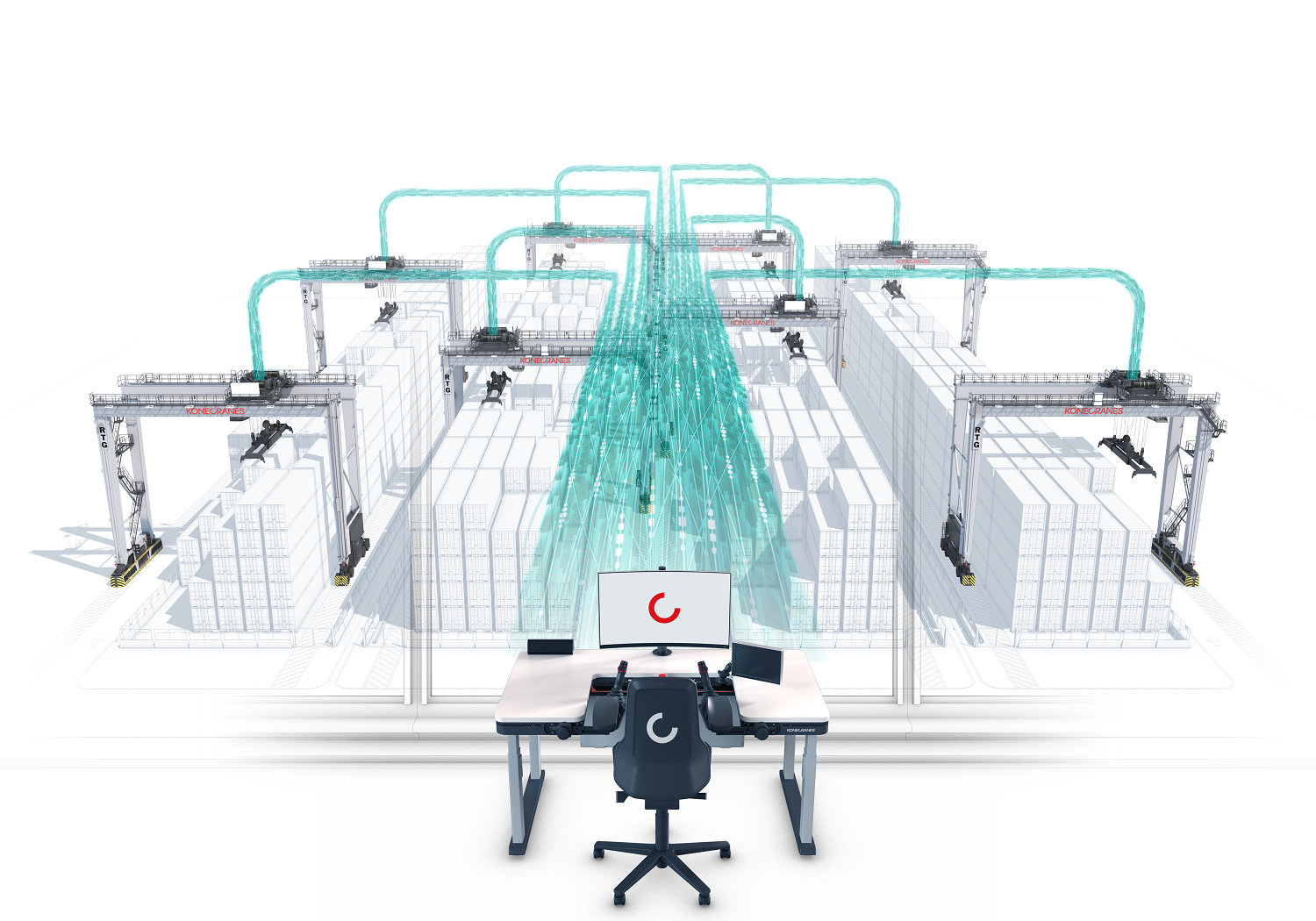
A drive and control system retrofit is an efficient and economical solution. At only 15-30% of the price of a new crane (depending on the options), a customer gets a crane with new, modern control and diagnostic systems, remote monitoring functions and full spare parts support from Konecranes. It uses high-speed standard data transfer via Ethernet and Profinet, and a modular PLC software structure allows smooth integration with other systems. For example, a crane could be connected via Ethernet with the terminal operating system (TOS). This lets the TOS exchange data with the crane, which is the first step towards terminal automation.