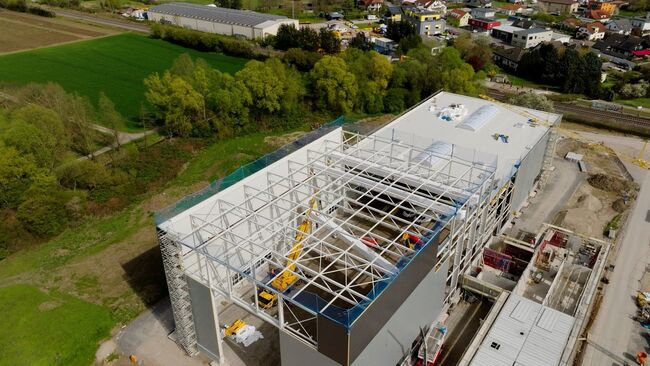
New production hall in Bad Schönborn: A tailored Konecranes crane system supports the safe and precise production of larger machines. (Image source: Konecranes)
Customer story 3 min read

Konecranes delivers heavy-duty crane systems for the FUCHS production facility in Bad Schönborn, Germany

When FUCHS – a Terex brand – built a new production hall at its Bad Schönborn facility in Germany to produce larger material handling machines for scrap, recycling, and port operations, the project required lifting equipment capable of handling upper structures weighing up to 230 tonnes.

To meet the demands of the new production environment, the company worked with Konecranes on a tailored crane installation built around safety, precision, and reliability.

Heavy-duty lifting for final assembly: Two Konecranes double-girder overhead travelling cranes (150 t and 80 t) operate in tandem to lift upper structures weighing up to 230 tonnes safely into position. (Image source: Konecranes)

Heavy-duty lifting for final assembly

A key stage in the production process is final assembly, where the upper structure of the machine is mounted onto the undercarriage. In its largest configuration, this upper structure can weigh up to 230 tonnes.

To support this operation, Konecranes installed two double-girder overhead travelling cranes with lifting capacities of 150 tonnes (2 × 75 t) and 80 tonnes (2 × 40 t) and a span of 32 meters.

A specially designed spreader beam connects to all four load hooks, enabling the cranes to operate in tandem. This configuration allows synchronized, stable, and precise lifting of the heavy components during final assembly.

Flexible pre-assembly: Konecranes cranes with lifting capacities of 32 t and 20 t support handling of components throughout the production process. (Image source: Konecranes)

Maximum flexibility in pre-assembly

In addition to the heavy-duty cranes used in final assembly, Konecranes installed further crane systems to support the pre-assembly of machine components.

The installation includes:

• One double-girder overhead travelling crane with a lifting capacity of 32 tonnes
• Two double-girder overhead travelling cranes with lifting capacities of 20 tonnes each

All cranes have spans of up to 31.5 meters and are equipped with either single or dual hoists depending on the production task. This setup allows components to be handled at different stages of the production process.

A tailored solution through close collaboration: Thanks to technical expertise and continuous coordination, Konecranes delivered an economically convincing crane system concept aligned with production requirements. (Image source: Konecranes)

Close collaboration delivers a tailored solution

Konecranes was selected based on its proposed crane configuration and its collaborative approach throughout planning and implementation.

At the start of the project, many technical requirements were still evolving. Continuous coordination between the teams allowed the specifications to be refined, resulting in a crane solution tailored to the production facility.

Technology designed for productivity and precision

The crane installation combines proven Konecranes standard components — supporting long-term service and spare parts availability — with features designed to improve productivity and load control.

Extended Speed Range (ESR) technology allows faster lifting and lowering speeds during empty runs and partial-load operations, improving overall cycle times and productivity.

Microspeed allows precise slow-speed control during the positioning of heavy components in final assembly.

The LoadFloating function holds the load through motor torque without immediate brake engagement, enabling particularly smooth, stable, and controlled load handling even at high capacities.

By combining standard components with advanced functionality, the installation delivers both high performance and dependable long-term operation.

Improved production efficiency: The Konecranes crane installation shortens cycle times, improves process reliability, and supports the production of larger machines at the Bad Schönborn site. (Image source: Konecranes)

Production advantages and improved efficiency


The new crane installation allows FUCHS to handle significantly larger machine components while supporting efficient production workflows.

Operators benefit from ergonomic and intuitive controls that simplify daily work and contribute to safer working conditions.

Together with modern control technology and a configuration tailored to the production environment, the cranes support lifting operations at the Bad Schönborn facility.

The project illustrates how the crane system was developed to meet the technical requirements of the new production facility.

Videos

Resource type: