The ongoing climate change challenges our way of life with impacts on the environment, health, and economies. Businesses need to do their part in mitigating climate change, and Konecranes wants to lead the way forward. We focus on helping our customers reach their decarbonization targets with electrified equipment and circular service offering as well as solutions for efficient material handling, finding low-emission opportunities with our steel suppliers, and working to decarbonize our own operations.
Konecranes' climate targets and progress
We have set ambitious targets for our own operations and for our value chain that are in line with the goal of limiting global warming to 1.5 °C.
The near-term targets have been first approved by Science Based Targets initiative (SBTi) in 2022 and upgraded in 2025, as we already reached our targets for own operations eight years in advance. We are committed to reducing absolute Scope 1 and 2 greenhouse gas emissions by 60 percent (progress in 2025: 54% reduction from 2019) and Scope 3 emissions, encompassing the use of sold products and purchased goods and services, 50 percent by 2030 from the 2019 baseline (progress in 2025: 20% reduction from 2019). In addition to the science-based targets, Konecranes aims to achieve carbon neutral manufacturing operations by 2030. Carbon neutrality means, first reducing absolute emissions as low as possible, and then offsetting the remaining unavoidable emissions through the purchase of verified carbon credits, delivering finance to emission reduction projects elsewhere.
In 2026, Konecranes announced its long-term climate ambition to reduce absolute Scope 1, 2 and 3 greenhouse gas emissions by 90% by 2050 from 2019 base year. The Scope 3 emissions include emissions from all reported emission categories, covering over 90% of Scope 3 emissions. The target reflects the same absolute GHG emissions reduction ambition as defined by the SBTi Net-Zero Standard but does not include neutralization of residual emissions and is not validated by SBTi.
The main contributors for Scope 1 and 2 emission reduction since 2019 have been the shift to renewable electricity in manufacturing and lower vehicle fleet fuel consumption due to the successful downsizing and progress with electrification. In 2025, we continued the vehicle fleet electrification, further improved energy efficiency and continued to increasingly use renewable energy in manufacturing. For Scope 3 emissions, the biggest impact comes from the emission category Use of sold products and is highly dependent on the yearly product mix sold. In 2025, several eco portfolio products like electric reach stacker, electric empty container handler, e-hybrid rubber tired gantry crane (RTG) and hydrogen fuel cell straddle carrier, were launched enabling emission reduction potential in the coming years. We also increased the use of low-emission steel in gear manufacturing.
Konecranes’ climate targets and progress
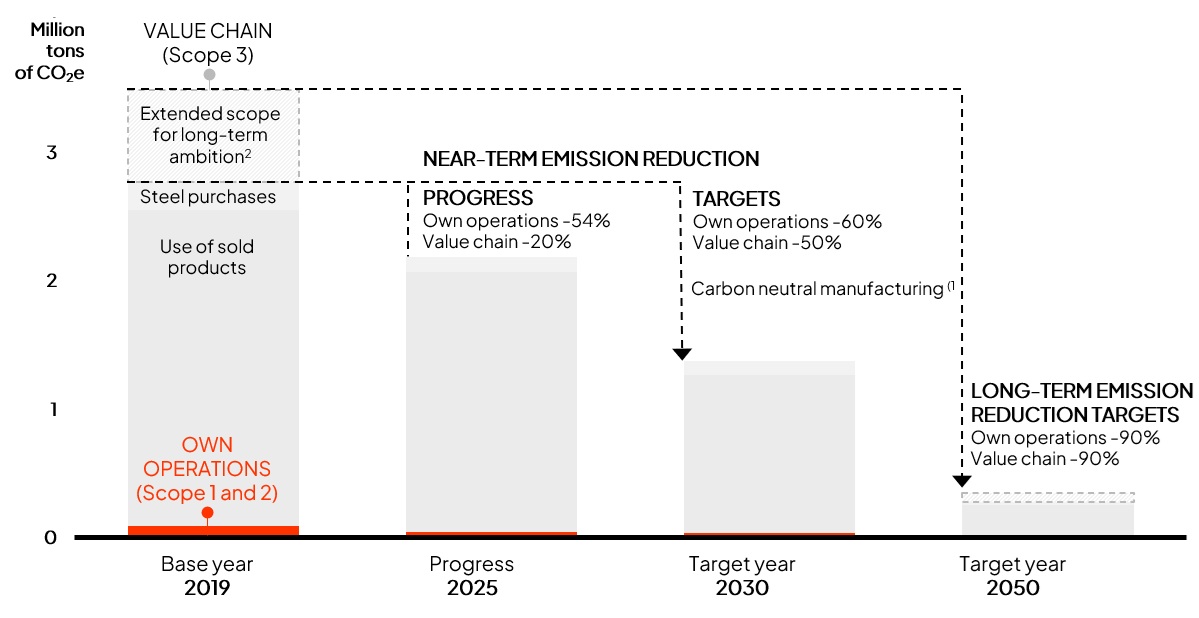
Image: 1) For 2030, Konecranes has a separate target of achieving carbon neutral manufacturing operations, meaning first reducing absolute emissions as much as possible, and then offsetting the unavoidable emissions through the purchase of verified carbon credits, which have an immediate impact by delivering finance to emission reduction projects elsewhere.
Reaching ambitious climate targets requires strong collaboration across the value chain. We work closely with both suppliers and customers to support the transition toward low-carbon solutions, while engaging our own employees to ensure that climate action is a shared effort across company. To strengthen internal awareness and involvement we organize internal events open for all employees covering environmental topics. We also deliver internal sustainability trainings for various topics and have recently introduced a new e-learning, which provides basic understanding of our sustainability commitments and actions – and highlights how each of us can contribute to our sustainability agenda.
Konecranes' emission inventory and transition plan for mitigating climate change
Our own operations (Scope 1 & 2) cover approximately one percent of our total emissions, while about 99 percent originate from the value chain. Most of these emissions are generated in two emission categories: Use of sold products and Purchased goods and services. In the Use of sold products, Port Solutions diesel-powered equipment contributes the most, also dominating our consolidated total emissions. The highest contribution from the category Purchased goods and services comes from steel.
Konecranes’ GHG emissions in 2025


