An overhead crane moving through a busy facility is easy to miss. People are focused on their work, noise levels are high, and the crane is up above—not where most workers are looking. By the time someone notices a load swinging overhead or a hook descending toward their work area, they may not have much time to react.
Safety lights change that equation. Mounted on the crane and projected down onto the floor, they put the warning exactly where workers are already looking, at ground level, in the space around them. Instead of relying on people to look up and track the crane, the crane announces itself.
A light for every situation
Not every facility has the same risks, and not every lift looks the same. That's why there are different types of safety lights, each suited to different situations.
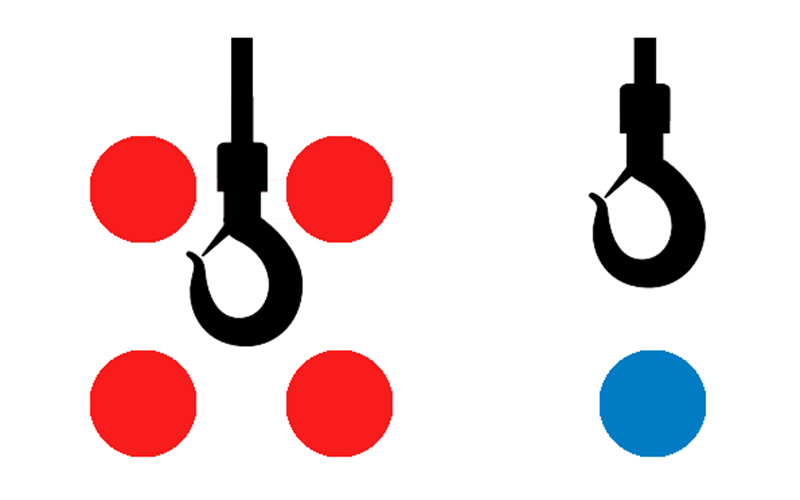 Spot safety lights project a strong, concentrated beam onto the floor or a target area. Think of them as the crane's way of saying "I'm here, and I'm moving." As the trolley travels or a hook starts descending, the light travels with it, giving workers a clear, moving signal to pay attention to. These work well in busy facilities where people may be anywhere under the crane's path like general manufacturing floors, warehouses and anywhere loads travel long distances.
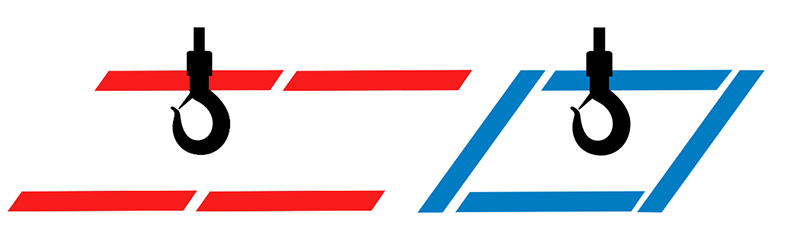 Line safety lights project a line across the floor for a bright, visible boundary that moves with the crane. Rather than just indicating the crane's presence, the line signals a clear message: don't cross here. For facilities with defined work zones or pedestrian paths that a crane regularly travels over, like assembly lines, this kind of barrier light is particularly effective. Workers learn to read the line the same way they read a traffic light. When it appears, they hold their position until the crane has passed.
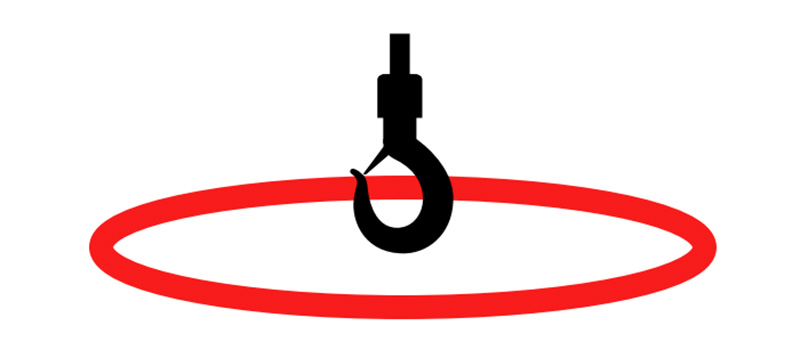 Projection safety lights work differently from the other two. Instead of following the crane's travel path, they put a large circular light on the ground directly below where the hook is going to land. This is about the destination, not the journey. When a load is coming down into an active work area, and workers are nearby, helping to guide it into position, knowing exactly where it's going to land gives everyone time to get clear. These lights are useful in fabrication shops, shipyards, heavy assembly environments and anywhere loads are being set down close to where people are working.
The right light for the right job
The best way to think about choosing safety lights is to think about where the risk actually is in your operation.
If your crane covers a lot of ground and workers are spread out across the floor, spot lights give broad, continuous coverage. If your crane follows a predictable route and the concern is workers crossing into its path, line lights create a clear, instinctive warning. If your biggest risk is loads landing near active work with riggers, assembly crews or anyone working close to the hook, projection lights address exactly that moment.
Many facilities use more than one type. A crane might carry line lights to warn of its approach, and projection lights to mark where the load is going down. Together they cover the full sequence of a lift, from the crane beginning to move, to the load touching down.
Why lights work when other warnings don't
Industrial environments are hard on attention. Noise can drown out alarms. Workers focused on a task may not notice a horn or a shouted warning. Looking up to track a crane while doing detailed work isn't realistic.
A light on the floor doesn't ask much of the people it's protecting. It's there, at eye level, moving in a way that's hard to ignore. It works for someone wearing hearing protection, for someone whose back is turned to the crane, and for someone new to the facility who hasn't yet learned to read every sound and signal.
That reliability is what makes safety lights worth considering for almost any overhead crane operation. The crane is always going to be harder to notice than equipment at eye level. A light on the floor meets workers where they are—and that's exactly where a safety warning needs to be.
Contact us to add safety lights to your crane.
Contact us
