Your overhead crane might be running every shift without a single breakdown. But running and running well are two different things. Some of the most damaging crane problems develop slowly and quietly, long before anything actually fails. Geometric misalignment is one of them.
Crane geometry refers to the physical alignment and positioning of the crane's structural components—like the bridge, end trucks, wheels and girders—and how well they are straight, square, and correctly oriented relative to each other. When these relationships drift out of tolerance, the crane starts working against itself, accelerating wear and placing unnecessary stress on components until something eventually fails. A crane geometric survey measures this alignment, giving you an accurate picture of where the crane stands and whether anything needs attention. It's one of the most useful diagnostic tools available to crane owners, and one of the most commonly overlooked.
Signs that geometry may be a problem
Geometric misalignment rarely announces itself dramatically. It tends to show up as a pattern of symptoms that, individually, might seem like ordinary maintenance items. Here's what to watch for:
Wheel flange and rail wear that seems heavier than it should be. When geometry is off, wheels and rails wear in characteristic ways. Flanges wear unevenly, rail wear is concentrated on one edge, or flat spots appear on wheels from sliding rather than rolling. If you're replacing wheels or rail sections more often than expected, geometry is worth investigating.
A crane that skews or crabbing. A crane that consistently drifts to one side during travel, rather than moving in a straight line, is fighting its runway geometry. Occasional self-correction is one thing. Persistent, directional skewing is a clear warning sign.
End trucks or drives behaving differently from each other. When the runway isn't in sync with the crane, the two sides of the bridge don't share the load equally. If one drive motor consistently runs hotter than the other, or the crane feels unbalanced in travel, geometry may be the cause.
Noise and vibration during travel. Grinding, rumbling or rhythmic banging, especially if it changes depending on where the crane is in the runway, often points to rail surface problems or poor wheel-to-rail contact tied to alignment.
Fasteners or structural connections that keep working loose. Misalignment generates lateral forces the structure wasn't designed to handle. If you're re-tightening the same connections repeatedly, or if cracks are appearing in end truck structures, that's worth taking seriously.
Premature bearing failures. Bearings that fail well ahead of their expected service life are often absorbing loads they shouldn't be. Misalignment is a common culprit.
When a crane geometric survey makes sense
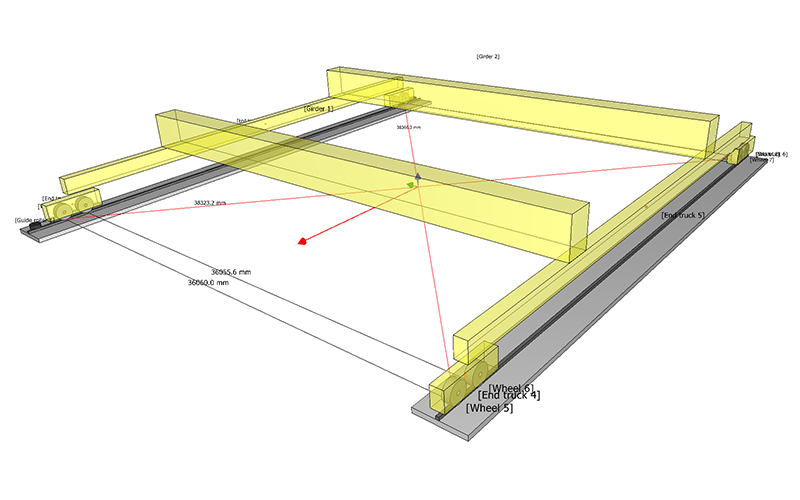 A geometric survey is useful across a number of different situations. If a crane is showing any of the warning signs above like skewing, uneven wear, premature bearing failures, or structural connections that keep working loose, a geometric survey is the right diagnostic step. It tells you whether misalignment is the root cause, so you're fixing the actual problem rather than replacing parts that will wear out again under the same conditions.
A geometric survey conducted before commissioning establishes a verified baseline—confirming the crane has been erected correctly and that all components are straight, square and within tolerance. That baseline becomes a valuable reference point for every inspection and survey that follows.
When a crane is being evaluated for upgrades or component replacement, a geometric survey helps define the scope. If the crane is out of tolerance, that needs to be part of the modernization plan. Otherwise, new components go onto a crane that isn't set up to get the most out of them.
Why it belongs in a preventive maintenance program
Preventive maintenance is about intervening before failure, not after symptoms appear. A geometric survey fits that logic well and it makes the rest of your maintenance program work better.
When components are replaced on a crane with undetected misalignment, the new parts start wearing immediately under the same adverse conditions. Catching and correcting geometry issues before replacement protects that investment.
Surveys conducted at defined intervals also provide valuable trend data. They can reveal measurements that are still within tolerance but steadily moving toward the limit, before wear patterns or operating symptoms appear. That visibility helps turn geometry issues into planned maintenance instead of emergency repairs.
The bottom line is that crane geometric surveys give you accurate information about a system that's easy to overlook until it becomes expensive. That's exactly what a good maintenance program is designed to do.
Contact us to schedule a CraneQ Crane Geometric Survey.
Contact us
