With a career spanning law enforcement, consultancy and the private sector, Antti Kurittu, Head of Cyber Defense, knows the value of boring days – and why cybersecurity today depends on teamwork. Cybersecurity protects the digital backbone of Konecranes’ smart lifting technology and material handling solutions, helping ensure safety in lifting operations.
A day when nothing happens is a good day
I’m old enough to appreciate a workday that’s not exciting. Earlier, as the incident response lead for a cybersecurity consultancy, we had some pretty exciting, tough days, such as when we worked on the major Vastaamo data breach case. What I’m trying to do now at Konecranes is to avoid those days.
I’m satisfied when I see that things work: our process is effective, and we have a system that functions as designed. Seeing all the pieces come together and everything flowing smoothly – that’s its own sort of pleasure.
How exactly cybersecurity is done can be technical and complicated, but in today’s world, cybersecurity is simply work that needs to be done so that businesses can continue uninterrupted. The consequences of disruption in the industrial sector can be huge, costing hundreds of millions.

All Konecranes operational technology is networked: our digital lifting solutions send and receive data, send telemetry and take instructions from computer programs. If we had a severe breach, the entire supply chain could be affected. It could mean that our cranes stop working at a port, shipping containers don’t get unloaded, then ports back up and there are downstream effects. You know what they say, a butterfly flaps its wings…
You can look at all the threats out there and get overwhelmed, but we put them into the context of our threat model to know what to defend against. At Konecranes we also have the experience to know what to pay attention to.
The boring stuff is the most important
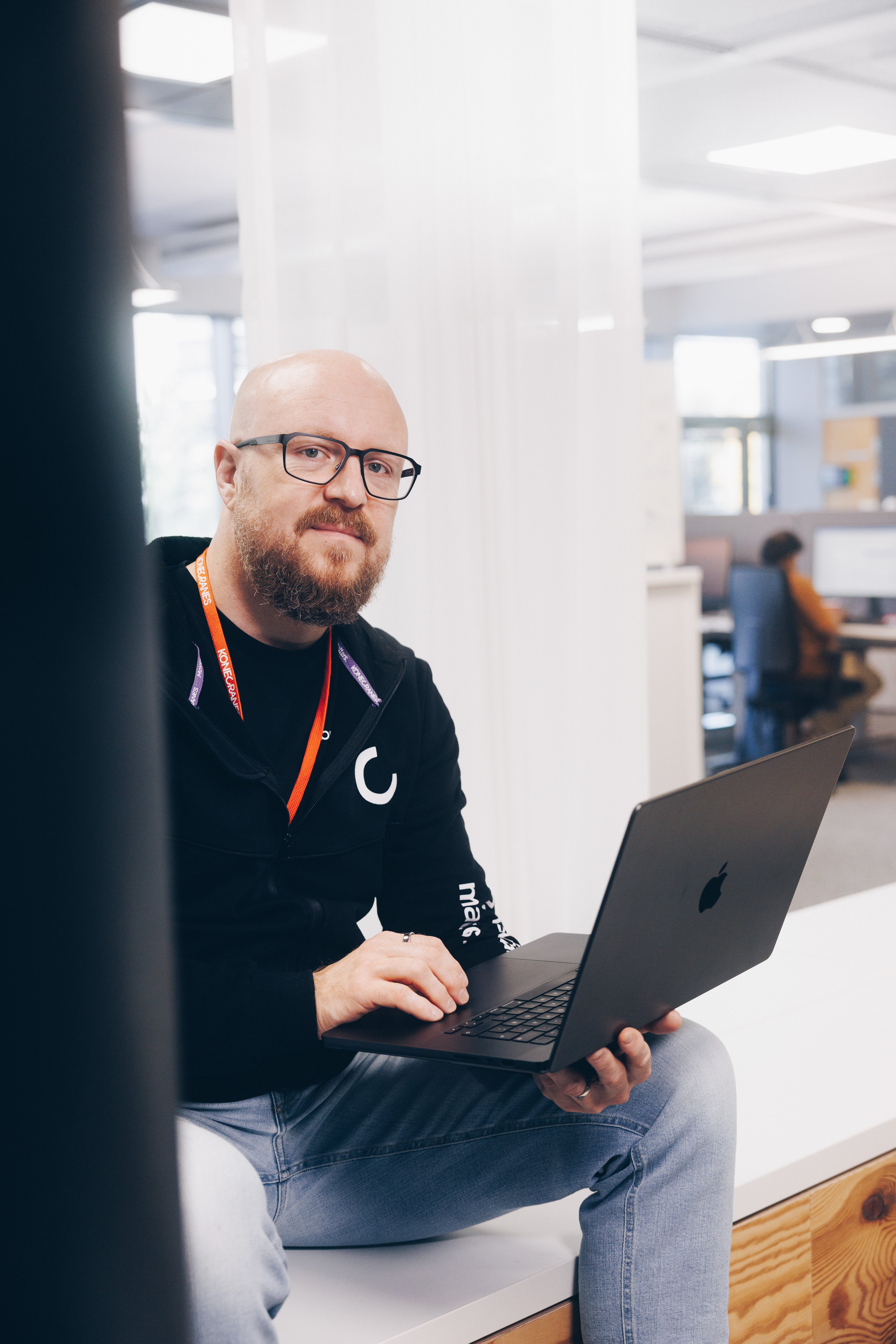
I’ve worked at small start-ups, big companies, consultancies, the government and law enforcement. No matter where I’ve worked, it’s the basics that you have to get right. That’s where most of the failures happen. It’s about getting the boring details correct, such as identity management and authentication, or securing the workstations.
You need to keep track of old systems, old servers, that one testing system that nobody remembers is still there. These are the systems criminals will find and then connect to your networks. It might be a server that was abandoned five years ago and nobody was responsible for updating.
AI introduces a whole new element. On the one hand you have the risk of data leaks when people use unsanctioned AI and your company data ends up on a random server, for example one hosted by a kid in their basement. On the other, attackers now have AI assistance. Sophisticated attacks were previously limited to those who had enough skills, resources and patience. But AI has democratized it: now a 12-year-old could have the same access to hacker techniques that used to be hard to come by. We work to stay a few steps ahead.
Like playing football with 15 balls
There’s this lore in the industry of the mythical hero hacker who defends against attacks, but that's not very accurate anymore. Today, it's a team sport. Nobody can actually master everything, and the deeper your expertise goes in one thing, the less useful you are as an individual if you're not a part of a skilled team that has a shared goal and good leadership.
My job is like playing football with 15 balls, you know, I just go and kick one ball a meter forward and then pass it to somebody else and then I go and kick the next ball and then the next ball. And I hope that, in aggregate, it makes a big impact. It’s all about teamwork.
I didn’t come to Konecranes for the cranes. It was our Chief Information Security Officer, Heidi Valkama. It was her vision, her energy and how she wanted to build a team that drew me in. I think the focus should always be on the cybersecurity team as a whole – that's the recipe for winning this game.