Konecranes Portal provides a single point of access to our digital customer platforms for industrial equipment, port solutions and lift trucks. View maintenance information and TRUCONNECT data, browse the store for spare parts, accessories and manuals, and discover what Konecranes has to offer.
Recent advances in the Internet of Things (IoT), data analytics and artificial intelligence (AI) have made it possible to realize digital twinning in a widespread manner. It can be immensely valuable in container logistics, improving traditional simulation and emulation thanks to its ability to continuously adapt in real-time. It can mirror the characteristics and behavior of its physical counterpart using real-time data and be used for real-time decision-making and performance prediction. Simulation/emulation and digital twinning share the goal of improving decision-making and efficiency while reducing risks, but their roles are different. They should be used in a complementary manner, helping to improve design, planning and operational decision-making in container logistics.
Throughout the history of human evolution, we have strived to develop tools and ways of thinking that aid our survival. As we moved from simple stone tools and hunting/gathering to settled, agricultural communities and layered societies, our technology began to improve in leaps, and we began to conceive of improving the lot of future generations. Indeed, we developed the concept of “the future” as a sense of time, not just in animal life, but also in the seasons, astronomy and the birth of mathematics. Fast-forward through millennia to the coming of electricity, computers and the digital age: today, we are using computers to create simulations of the future based on models drawn from the real world. Our concept of the future has become much more sophisticated.
Most people are familiar with computer simulation from weather measurement and climate modelling, but it is common in many industries that require large capital investments to deal with the future. We cannot predict the future, but we can make better decisions based on known, adjustable factors in the here and now.
Computer simulation is increasingly used, and increasingly valuable, in container logistics - the global web of container movement that occurs across the oceans, seas, container terminals, intermodal terminals, roads and railways. As container logistics shifted from analog to digital with increasing computerization and internet connectivity, we began to build computer simulations using models that accurately mimicked real-world container movements, allowing for experimentation and prediction that did not affect real-world systems. Experience grew in this area and today computer simulation is widely used in container logistics to support daily operations, improve efficiency, and reduce costs.
Simulation models are approximations of real systems and will therefore always give a measurable performance difference known as the “credibility gap”. Emulation models aim to minimize this gap by integrating real system components into the simulation model, bringing the model closer to reality.
Computer simulation and emulation are essential tools in the work of designing container terminals, in predicting capacity demand as part of capacity planning, and the overall optimization of container handling. Container handling equipment manufacturers use computer simulation when designing and testing equipment before the manufacturing phase begins, to reduce risks and help ensure the required equipment performance.
The power of computing has been growing very fast, and advances in software engineering and computer modelling techniques have allowed the creation of user-friendly, widely available simulation and emulation tools and libraries. Some simulation tools are tailored for specific areas of container logistics, while others are applicable across many areas. Regardless of the area in question, in order to develop a high-fidelity model, we must collect a large amount of historical data, verify and validate the model, experiment with various scenarios, and analyze the results carefully.
Container logistics simulation experiments are usually carried out independently of real-world systems in a virtual computer environment. This is a basic necessity in container handling. Live operations must not be affected while simulation experiments are carried out using historical data and applying different scenarios.
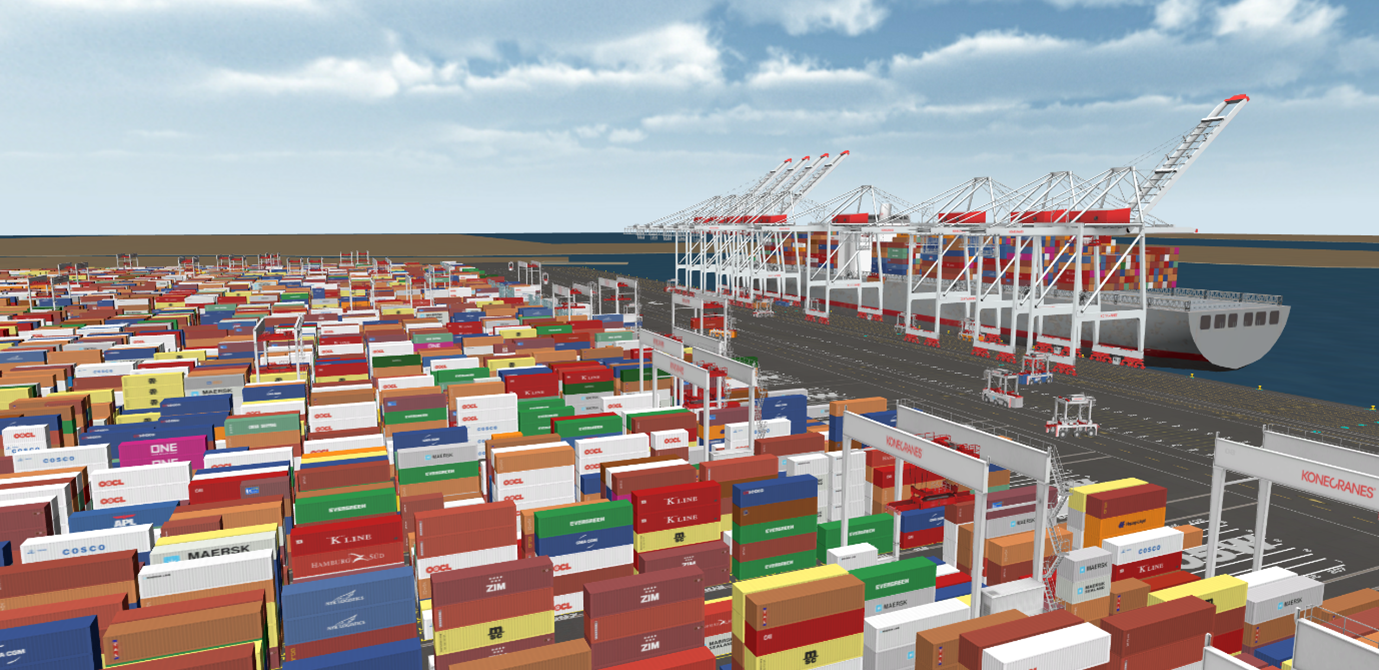
That said, in the last decade or so it has become more common to integrate simulation models with real-world systems to a certain controlled degree, because more accuracy can be achieved. An outstanding example in container logistics is Konecranes’ CONTROLS product, which is used to build high-fidelity simulation models of container terminals. The model includes the container handling equipment, operational behaviors, and the operating rules of the terminal. It is connected to the terminal’s Terminal Operating System (TOS) and Equipment Control System (ECS). CONTROLS carries out long-term (one or more work shifts) experiments to gather the terminal’s productivity and performance KPIs. The primary goal is to test and optimize the TOS and ECS using the high-fidelity CONTROLS simulation model. This emulation approach is particularly beneficial when the real-world systems are difficult and expensive to test in real-life operations.
For over twenty years, Konecranes’ CONTROLS product has been used to test TOS, ECS and equipment performance emulators. It has played a central role in successfully completing major container terminal automation projects around the world, improving productivity by evaluating different operating scenarios and terminal configurations via the TOS and ECS systems. It has also proven to be effective in training terminal personnel in the lab environment, preparing them for what they will face when the terminal goes live.
3D illustration: CONTROLS emulation environment
The value of computer simulation and emulation has been proven in the real world of container logistics. Meanwhile, around twenty years ago a powerful new digital concept was introduced - digital twinning – which has come into its own in the last five or so years.
Michael Grieves introduced the concept of the digital twin as “a virtual representation of a physical product that is tightly coupled through data flows across its entire lifecycle. It is a living model continuously informed by the physical asset and capable of information actions on that asset.”
Like a high-fidelity simulation model, a digital twin is a virtual representation of its real-world counterpart. It is integrated with the real system it represents. It is continuously updated and can help to improve decision-making by giving real-time performance insight and revealing potential problems in the real-world asset.
Simulation is used to replicate the behavior of a system, making repeated experimentation possible to reveal the different outcomes of different operating scenarios. Emulation partially integrates the simulation model with the real-world system to reach the larger goal of more accurate predictions by bridging the credibility gap. Going further, the digital twin can potentially offer even closer virtual representation of the real-world system, giving maximum-fidelity simulation that runs in real-time with continuous updating, enabling ongoing monitoring, analysis and optimization of the real-world system.
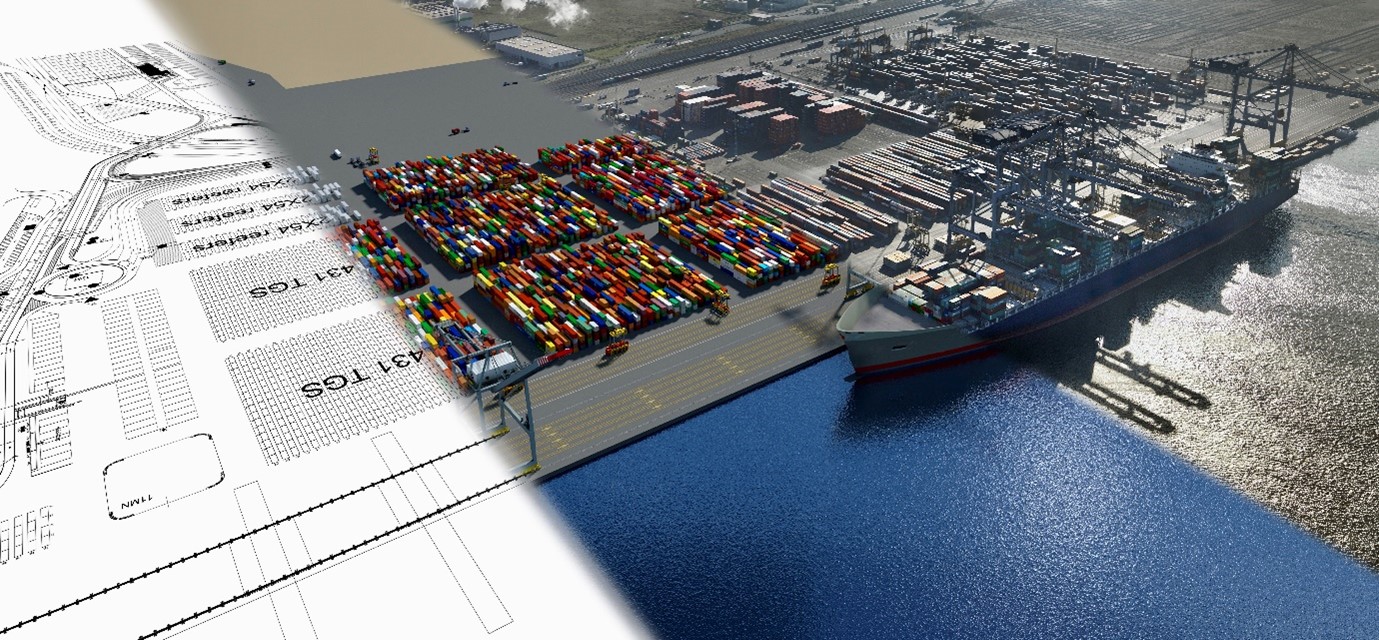
Recent advances in the Internet of Things (IoT), data analytics and artificial intelligence (AI) have made it possible to realize digital twinning in a widespread manner. It can be immensely valuable in container logistics, improving traditional simulation and emulation thanks to its ability to continuously adapt in real-time. It can mirror the characteristics and behavior of its physical counterpart using real-time data and be used for real-time decision-making and performance prediction. Simulation/emulation and digital twinning share the goal of improving decision-making and efficiency while reducing risks, but their roles are different. They should be used in a complementary manner, helping to improve design, planning and operational decision-making in container logistics.
Illustration: From design to operation
In the early phases of container terminal (re)design or expansion, simulation plays a crucial role. It involves simulating various quay lengths and determining the optimal number of quay cranes for efficient crane utilization at the quayside. Additionally, it assesses different yard configurations and container block arrangements, identifies the necessary horizontal transportation with an appropriate road network, and designs optimal gate and rail systems for landside operations. All of these elements are evaluated under different container handling scenarios to ensure thorough planning and successful real-world operation.
Once all of the infrastructure, equipment and software are in place, the next step is to initiate the commissioning tests for the equipment and the software products that will operate in the container terminal. Emulation plays a crucial role in this phase. As mentioned earlier, with products like CONTROLS, the container terminal can be readied for a successful go-live by testing the Terminal Operating System, Equipment Control System, and any other software systems in advance.
After the go-live phase, emulation can still be used to test the new Terminal Operating System releases or to optimize planning strategies by experimenting with different operating parameters. At this stage, the terminal is fully operational, equipped with the necessary equipment and control software systems that are generating a substantial amount of data. This data is continuously fed into the digital twin, the high-fidelity model that represents its real-world counterpart. Using the live data, the digital twin can monitor its physical counterpart in real-time, providing insights into operational inefficiencies, proactively suggesting solutions, and predicting necessary maintenance to enhance operational efficiency.
Konecranes provides service, equipment and parts in a wide variety of industries around the world.
Don't see your country listed here? Find a location near you or contact us for availability.