Automation for the paper and forest industry

paper factory 3D layout

Maximizing productivity with automation

Paper and forest is an industry tailor-made for automation. When it comes to choosing the right level of automation, it’s important to understand the nature of what you are machining as well as your specific requirements and capabilities. In several critical areas of the mill, automated cranes can help reduce labor costs, optimize storage, track inventory, reduce roll damage, increase productivity and lower the capital expense associated with forklift systems.  Moving into the future, automation is taking an ever-larger role in promoting mill safety, productivity and profitability.

Semi-automation with Smart Features

With semi-automation a crane operator retains manual control with various features assisting. Konecranes Smart Features are a special combination of crane components and software designed specifically to improve the safety and productivity of your operations with software-based intelligence that provides total control over process tasks. Operators become more efficient due to shorter load cycle times and because the control system optimizes crane movement, your crane and its components wear more slowly, extending the life of the crane.

SF_sway
SF_sway

Sway Control

Sway Control limits load swing by controlling the acceleration and deceleration of the bridge and trolley, enabling faster load handling and more precise positioning. The operator can use full crane, trolley, and hoists speeds even while driving close to the walls, and the risk of grab damage is reduced. A recent study confirmed that cranes with Sway Control are 60% faster than an ordinary crane.

SF_inching
SF_inching

Inching

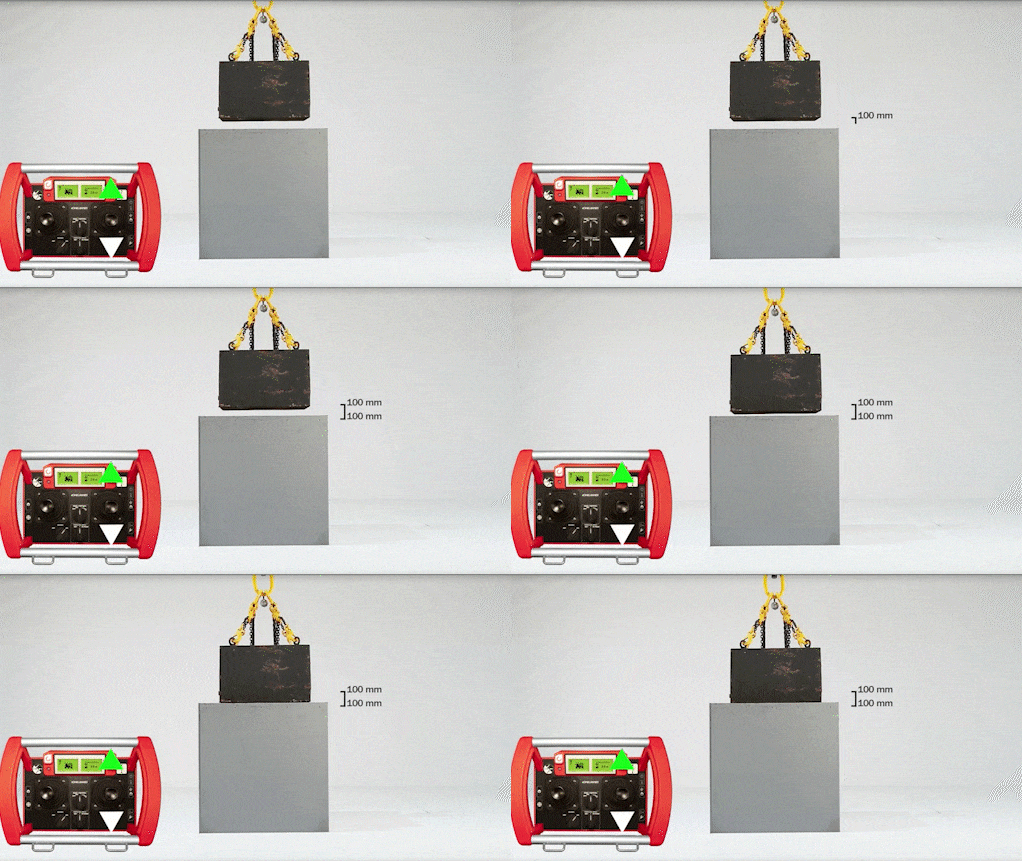
Inching improves accuracy by allowing the operator to move the load in small increments of 2 mm to 100 mm. The crane stops after it has moved the set inching distance. Operators can set increments on the user interface when starting up the crane, with the possibility to program a different distance for each motion.

SF_target
SF_target

Target Positioning

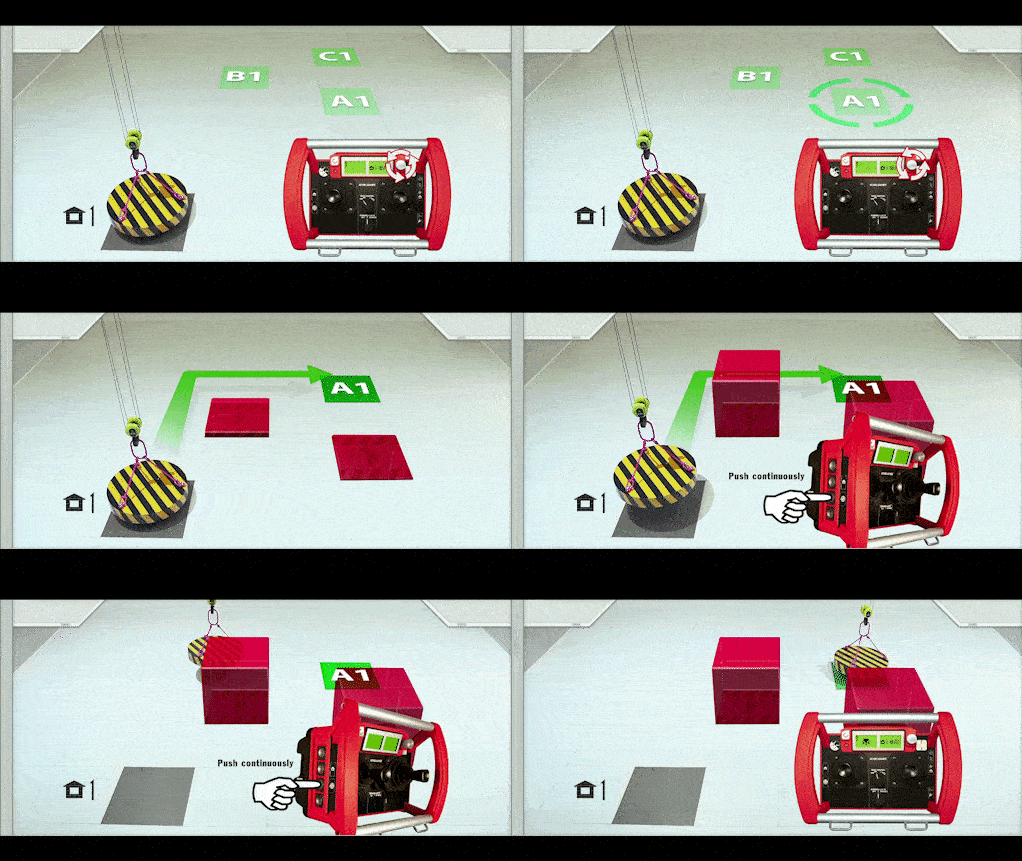
Target Positioning moves the load from one of eight home positions to one of 120 possible preset target positions within a predefined area. The crane slows down, stops and lowers the load at the set target point. Just one button automatically returns the crane to its home location.
The Konecranes Target Positioning feature has been designed to reduce cycle times and to enhance safety.

SF_protected
SF_protected

Protected Areas

Protected Areas can be used to assign spatial parameters for crane operation, automatically limiting crane movement to designated working areas only. Managers can pre-program no-go areas to keep the crane from going where it shouldn’t. This maximizes crane operation space while helping to reduce the risk of accidents, equipment collisions and load damage. Protected Areas allocates up to 16 permanent “no-go” zones to limit the crane’s movements to preset working areas. 

SF_endpos
SF_endpos

End Positioning

End Positioning allows operators to set the exact destination of a load and the outside area, or “window” for manual navigation. Once the operator brings the crane to the window, the End Positioning button automatically sends the crane to its final position. As a safety feature, the operator lowers the load manually to complete the movement.

service personnel
service personnel

Fully automated paper storage

With full automation, the crane operator sets the parameters and the crane operates independently. Our Automatic Storage and Retrieval System (ASRS) can evolutionize productivity, especially in mills with limited space. A fully automated crane increases handling speed, stacking paper or tissue rolls much higher in less space than comparable forklift systems, without requiring floor space for aisles. ASRS systems are also designed to be safe around people. Access to the automated area is synchronized with crane operation, so that access is only allowed when the crane is set to stand-by state. And separate protected areas can also be set inside the normal operating area of the crane.

Konecranes parent roll handling crane

Automation in parent roll handling may pay for itself

Parent roll handling cranes can handle full rolls and return the empty shafts on semi-automatic mode to and from the paper machine pope winder. Using this approach, jumbo roll stands can replace expensive traditional conveyor systems. Lifting beam hooks with mechanical locking devices and positioning sensors provide better operational safety, in both manual drive mode and semi-automatic drive mode.

Safety is also improved because an operator does not need to be nearby—the crane works in a totally closed area. Eliminating the conveyor rails can save you far more than the cost of automating the crane, allowing you to recover your investment sooner.

Automated train loading system

Video cannot be shown.
You must accept cookies in the "Targeting" category to view videos.

Our newest automation innovation can move 1,100 tons of pulp per hour onto train cars. This fully automated system also fills a 1,400-ton buffer at the railway platform twice a day. The cranes move 32 tons with each lift compared to a maximum 8 tons for a forklift, saving not only time, but also significant labor and capital costs. It is also possible to drive the cranes manually, assisted by Konecranes Smart Features for faster and easier positioning and safety. In addition, the crane system has an interface for personnel access control to prevent people from entering the working area when cranes are operating in automatic mode.

Interested? Contact us

Yes, I am interested in receiving news updates and marketing information about Konecranes products and services.